

A free t-shirt is the easiest marketing idea in the world to pitch — and the easiest one to waste money on. You've seen the proof in your own closet: somewhere in there, there's a logo tee from a conference you can't remember, folded next to one you got at a 5K in 2019. They're not bad shirts. They're just shirts that didn't earn a job.
Then there are the other ones. The Hard Rock Cafe shirt your uncle won't stop bringing up. The Patagonia tee that actually made you respect the brand more. The MailChimp drop that 1,000 people fought to claim in under three minutes.
We pulled 12 of the most successful custom apparel campaigns ever — Coca-Cola, Dr. Pepper, Nike, Lululemon, Patagonia, and a marketing agency that turned a few extra tees into half a million dollars in revenue — and looked at what they actually had in common.
Five patterns showed up in every single one. If you're planning a campaign, designing for a client, or just trying to build something people want to wear, this is the cheat sheet.
1. The Shirt Has to Be Earned, Not Just Given
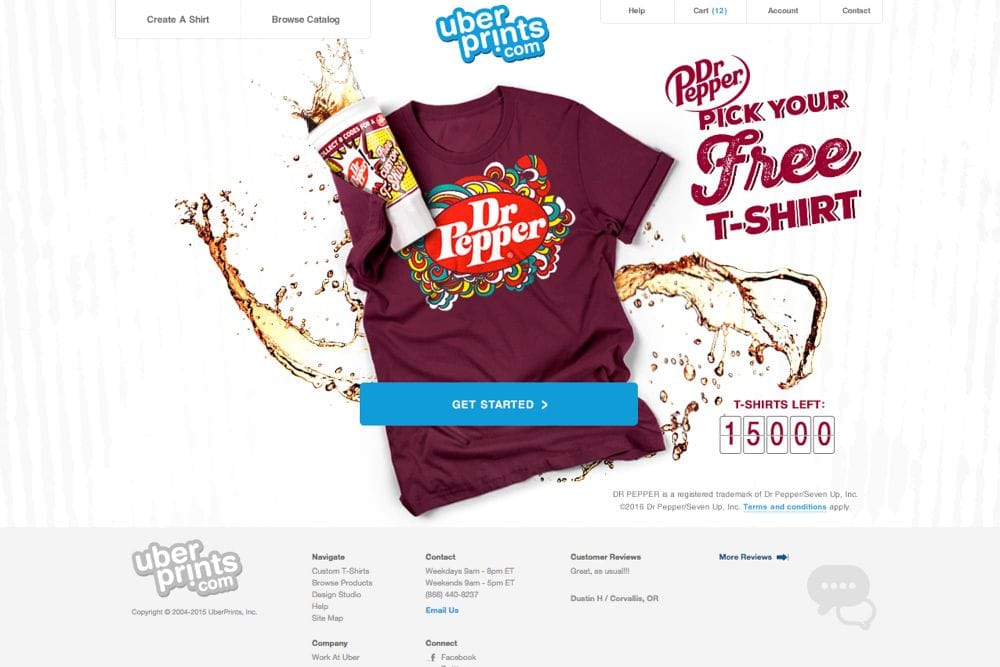
The best campaigns made customers do something before they got the shirt. Coca-Cola made you tweet. Dr. Pepper made you collect eight cup codes. Nike makes you a member. MailChimp made you refresh your feed at exactly the right second.
That's not a marketing trick — it's a psychological one. A shirt you worked for is a shirt you wear. A shirt that showed up in your conference swag bag is a shirt that becomes a paint rag.
The mechanic doesn't have to be hard. It just has to exist. "Tweet a hashtag" is enough. "Show up to the event" is enough. The point is that the shirt represents something the wearer did — and that's what makes them put it on Saturday morning instead of stuffing it in a drawer.
What this looks like for you: If you're giving shirts to a fundraiser, group order, or campaign, build in a small "did something" moment before the shirt drops. Sign up by Friday. Hit the donation goal. Show up to the kickoff. Suddenly the shirt is a trophy.
2. Scarcity Creates Stories
MailChimp gave away 1,000 shirts. They could've shipped them all in one Tuesday email. Instead, they dropped them in batches — and one batch sold out in two and a half minutes.
That detail is the whole point. "I gave away 1,000 free shirts" is forgettable. "100 shirts gone in 2:30" is a tweet. It's a story. It's the reason somebody who wasn't even there is still talking about it.
Hard Rock Cafe figured this out a different way — their Tokyo shirt is only available in Tokyo, and that's why people fly home with one. Lululemon flat-out names their drop strategy "We Made Too Little." Selling fewer shirts on purpose is a real strategy, and it works because scarcity isn't a feature of the shirt — it's a feature of the story around the shirt.
What this looks like for you: Limited runs beat unlimited inventory. A drop that's "only available until Sunday" or "only 50 made" gives the wearer something to brag about. That brag is your marketing.
3. Great Shirts Signal Membership in Something Bigger
Nobody wears a logo tee because they love the logo. They wear it because of what the logo says about them. Tens of thousands of women in Spain's Carrera de la Mujer don't wear pink because pink is their color — they wear it because tens of thousands of other women are wearing it too, on the same morning, in the same city. The shirt is the membership card to a movement.
Same logic for England's rose rugby shirts ("I support the team"), Hard Rock's location shirts ("I've been to Tokyo"), and Nike's member-only drops ("I'm an insider"). The shirt isn't apparel — it's identity, on a hanger.
If your shirt design is just your name and a slogan, you're competing with every other shirt in the closet. If your shirt says I belong to this thing, you've made a piece of identity. People wear identity in public. They don't wear logos.
What this looks like for you: Before you finalize a design, ask: what does this shirt say about the person wearing it? "I'm part of the team." "I was there in 2026." "I'm the one running this group order." If you can answer that, the design is doing its job.
4. Free Shirts Aren't a Cost — They're a Channel
A marketing agency called Single Grain traced over $500,000 in revenue back to a pile of free t-shirts.
The CEO didn't plan it. He had extra branded shirts, posted on Facebook asking who wanted one, and noticed people were running into Single Grain customers because of the tees. So he leaned in — eventually started giving people multiple shirts to share with friends, and turned the whole thing into a real distribution channel.
The reframe matters. If a shirt is a "cost," you'll always print as few as possible and hand them to whoever's nearest. If a shirt is a channel, you start asking better questions: who should be wearing this? How many do they need? What rooms can this shirt walk into that an ad can't?
A $20 shirt on the right person reaches places no paid campaign can buy its way into.
What this looks like for you: When you're planning a giveaway, don't budget shirt-by-shirt — budget reach-by-reach. A few shirts to one well-connected customer often beats one shirt to a handful of strangers.
5. Authenticity Has to Be Backed by Infrastructure
Patagonia ran a full-page New York Times ad on Black Friday 2011 that said "Don't Buy This Jacket." Their revenue grew roughly 30% the following year — from around $415 million to $543 million.
Most brands look at that and think the ad was clever. The ad was barely the point. The reason the campaign worked was that Patagonia had years of actions to back it up — the Worn Wear resale platform, free repair guides, the take-back recycling program, 1% of every sale going to environmental groups. The ad wasn't a stunt. It was a statement that the company had already earned the right to make.
Most brands try to do the campaign without the infrastructure. It doesn't work. It can't work. People can smell it.
If your t-shirt campaign is making a claim — about your community, your values, your quality, your craftsmanship — there has to be something real underneath it that's bigger than the campaign itself. Otherwise it's a costume.
What this looks like for you: Don't build a campaign around something you'd have to start doing. Build it around something you're already doing that nobody knows about yet.
So Where Does That Leave Your Next Shirt?
Five patterns. They show up over and over, across two decades, across industries, across budgets that range from "a few extra tees" to "full-page New York Times ad."
The takeaway isn't that you need to be Patagonia or Nike. It's that the same mechanics work at any scale. A 50-person company can run a scarcity drop. A nonprofit can build a "shirt as identity" campaign. A small business can hand out shirts in fives instead of ones.
You don't need a bigger budget. You need to get creative.
Want to put one of these patterns to work? The UberPrints Design Studio is built for exactly this kind of campaign — limited runs, group drops, custom designs, no-minimum orders. Start designing →